Everyone who has thought seriously about building an app has run into the same wall. You search for what it costs, and you get either a number so wide it's useless or a form that wants your phone number before it'll tell you anything. Neither helps you decide whether to start.
The honest answer is that app pricing behaves like construction pricing. There's no cost of a building, only the cost of a specific building. But the drivers are knowable, and once you understand them you can estimate your own project reasonably well.
Why You Never Get a Straight Number
An app is a set of decisions, and almost none of them are made when you first ask the question. How many types of user are there? Does it need to work offline? Does money move through it? Does it talk to systems you already run? Each answer moves the price by a meaningful amount, and until they're answered any figure is a guess dressed up as a quote.
This is also why the first serious conversation with a developer should be about scope rather than price. A good one will push you toward a smaller first version, because that's the only reliable way to lower the number.
The Ranges You'll Actually See
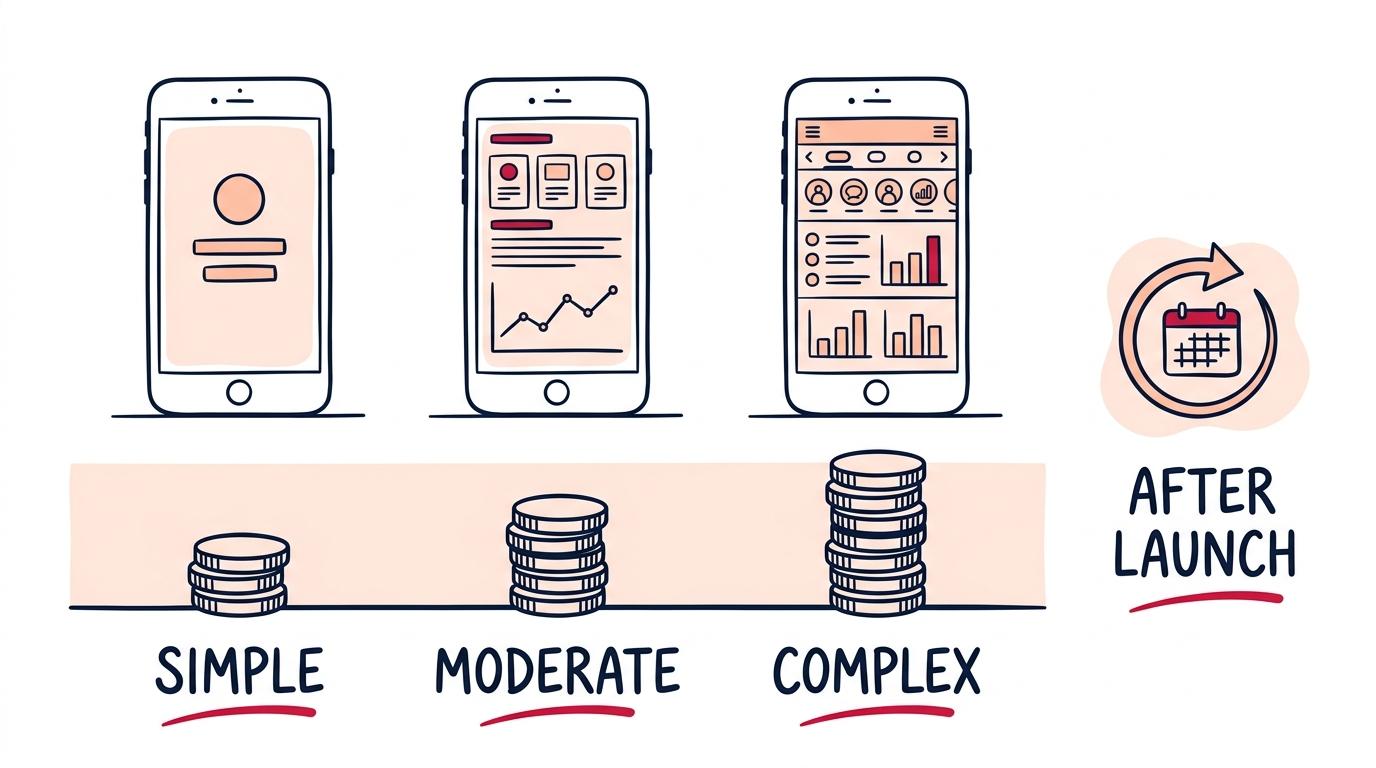
In practice, most projects land in one of these bands.
- Simple, roughly 20,000 to 50,000 dollars. One type of user, a handful of screens, no payments, no heavy integrations. An internal tool, a booking app, a straightforward directory.
- Moderate, roughly 50,000 to 150,000 dollars. Multiple user roles, accounts and logins, payments or subscriptions, some third party integrations, an admin area. Most real products live here.
- Complex, 150,000 dollars and up. Real time features, heavy data work, strict compliance, multiple platforms maintained in parallel, or anything where reliability failures are expensive.
If those numbers are higher than you expected, that's the normal reaction. It's also the reason the next section matters more than this one.
What Pushes the Price Up
The features that sound small in a sentence are often the ones that carry the most engineering behind them.
- User accounts and permissions. The moment different people see different things, complexity multiplies.
- Payments and subscriptions. Handling money means handling failure cases, refunds, retries, and tax.
- Third party integrations. Every external system is another thing that can change underneath you.
- Real time anything. Live chat, notifications, and collaborative editing are far more work than they appear.
- Multiple platforms. Web, iOS, and Android are three surfaces to build and maintain, not one.
- Custom design. A distinctive interface costs more than assembling standard components.
When we built Forekala, a household budgeting product, the expensive parts weren't the screens people see. They were bank synchronization staying reliable, shared household accounts where several people touch the same budget, and an assistant that could explain the numbers. Those three decisions defined the budget more than the entire visual design did.
Where the Money Actually Goes
Inside a build, the split is fairly consistent and rarely matches what people expect.
Roughly a fifth goes to discovery and design, meaning working out what the thing does and how it should feel before anyone writes code. Somewhere around half is engineering. Testing and fixing is often a quarter on its own, which surprises people who assume testing is a final check rather than a continuous cost. The rest is project management and the work of actually getting it into an app store or onto a server.
Two things follow from this. Testing isn't the place to economize, because the failures it catches are the ones that make people abandon a product. And the discovery portion, which feels like the least productive phase because nothing is being built, is what determines whether the expensive half gets spent on the right thing.
Fixed Price or Hourly
You'll be offered one of two arrangements and they fail in opposite directions.
Fixed price gives you certainty and forces the scope to be pinned down in detail before work starts. The cost is rigidity. Anything you learn mid project becomes a change request, and a developer carrying the risk of an underestimate will price defensively.
Time and materials flexes as you learn, which suits products where the right answer emerges from building. The cost is that the total isn't known upfront, and without discipline it drifts.
For a first version with a genuinely fixed scope, fixed price is reasonable. For anything exploratory, hourly with an agreed budget cap and regular checkpoints tends to produce a better product for the same money. What matters more than the model is whether you see working software often enough to catch a wrong direction early.
The Costs That Arrive After Launch
Launch isn't the last invoice, and planning as though it's causes more project failures than underestimating the build.
- Hosting and infrastructure, which scales with usage.
- Third party services, things like payment processing fees, email delivery, and data providers.
- Maintenance, typically 15 to 25 percent of the build cost annually. Operating systems change, dependencies age, and security patches aren't optional.
- Improvements, because the version you launch is never the version people end up wanting.
How to Get a Smaller Number
The lever is scope, and it's close to the only lever that doesn't damage the result.
- Cut to one user type for version one. Serve the person whose problem is most acute and add the rest later.
- Use existing services instead of building your own. Authentication, payments, and email are solved problems. Paying for them is cheaper than building them.
- Pick one platform to start. A responsive web app reaches everyone and costs a fraction of two native apps.
- Defer the admin panel. Early on you can often run operations manually and learn what the panel actually needs to do.
- Write down what version two is. Naming the cut features as deliberately deferred rather than rejected makes them much easier to leave out.
Who Builds It Changes the Number
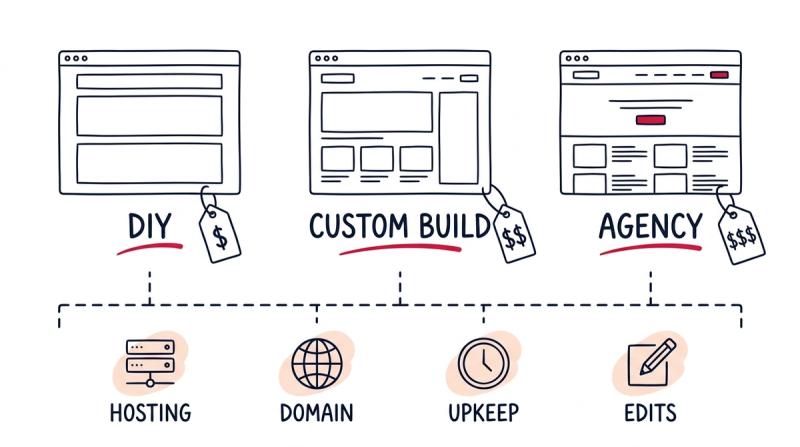
The same specification priced by different kinds of team can vary by a factor of five, and the cheapest isn't automatically the worst choice.
- A solo developer or small studio is typically the lowest cost and the most direct to work with. The risk is capacity. One person has one person's availability, and if they move on you need a handover.
- A domestic agency costs the most and brings process, multiple specialists, and continuity. Worth it when the project is large or when losing one person can't be allowed to stall it.
- An offshore team can cut the hourly rate substantially. The savings are real, and so is the overhead of time zones, communication, and the review effort needed to keep quality consistent.
- Building in house looks cheapest until you count recruitment, salary, and the months before a new hire is productive. It makes sense when software is going to be a permanent part of the business rather than a one time project.
The useful comparison isn't the hourly rate. It's the total cost of getting to something that works and can be maintained afterwards, which is a different figure.
Questions Worth Asking Before You Sign
- What's in the first release, screen by screen?
- What happens when the estimate turns out to be wrong?
- Who owns the code and the accounts?
- What does support cost after launch?
- Can I see something working before the whole thing is finished?
That last question separates approaches more than any other. Building in small working increments means you see progress you can react to, rather than waiting months to find out whether the thing matches what you had in mind.
Pay for the Version You Can Learn From
The cheapest successful app is almost never the one with the lowest quote. It's the one scoped tightly enough that it ships, gets used, and tells you what to build next. Every feature you add before launch is a bet placed without information, and most of those bets are wrong.
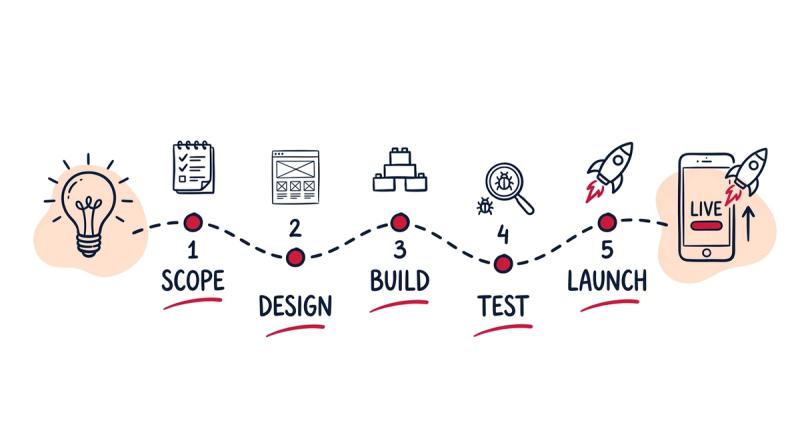
We wrote more about the sequence itself in From Idea to Launched App, and the way we approach software development follows from it. Scope small, ship something real, then let the people using it decide what comes next.