Ask three people what a small business website costs and you'll get three answers that are thousands of dollars apart. None of them are lying. Websites are priced like renovations rather than like products, so the number depends almost entirely on what you're asking for and who's doing the work. The problem is that most business owners are asked to choose before anyone explains what separates the cheap option from the expensive one.
Here's what actually sits behind those numbers.
Why the Range Is So Wide
A website isn't one thing. It's a design, a set of written pages, a technical build, a hosting arrangement, and an ongoing maintenance commitment. A template you fill in yourself covers the first three thinly and leaves you the rest. A custom build covers all of them deliberately. Both are called a website, which is why the quotes look irreconcilable.
The other reason is that a lot of the cost isn't in building the pages at all. It's in deciding what the pages should say, who they're for, and what you want a visitor to do. That work happens before anyone opens a design tool, and it's the part that most separates a site that earns leads from a site that just exists.
The Tiers You'll Actually Encounter
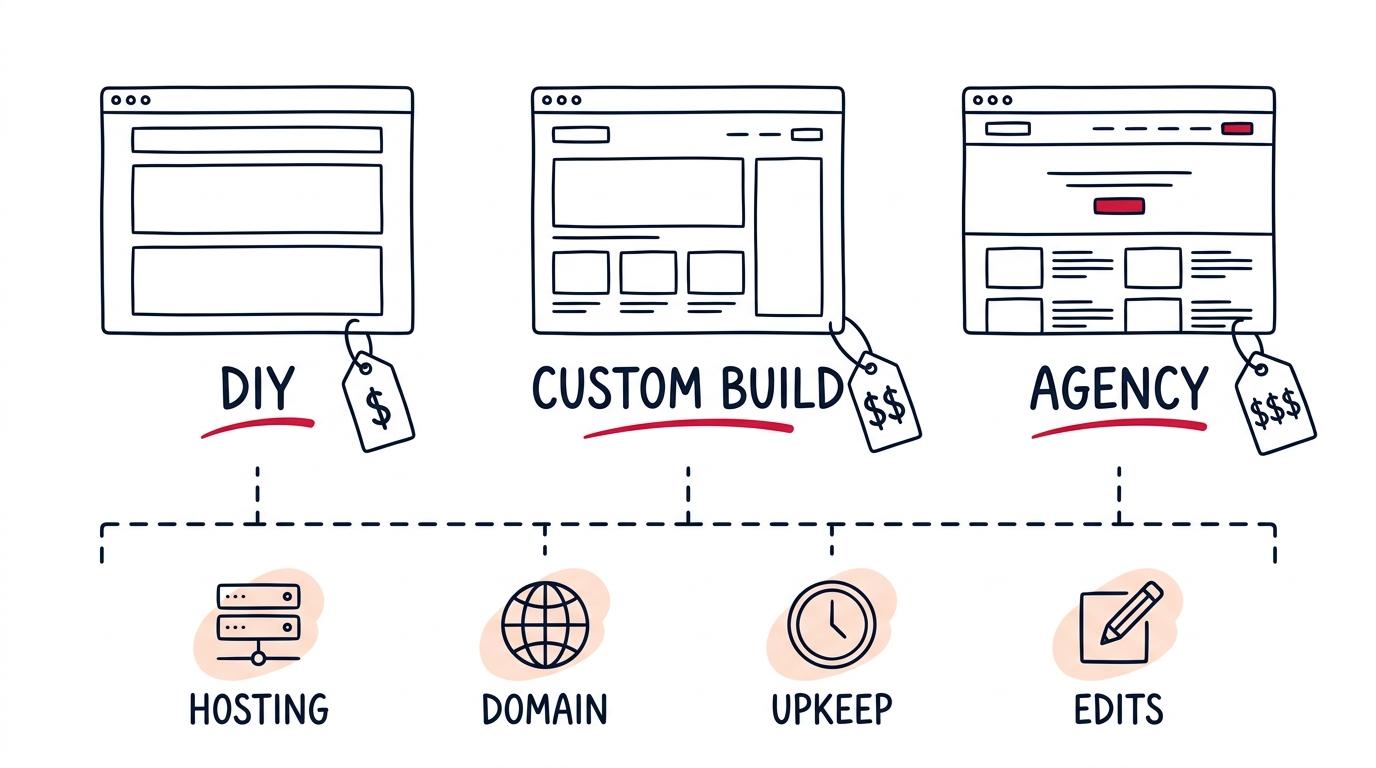
Most quotes fall into one of three bands.
- Do it yourself, roughly 200 to 800 dollars a year. A website builder subscription, a template, and your own time. Genuinely fine for a brand new business that needs to exist online and has no budget. The real cost is the weekend you spend on it and the ceiling you hit later.
- Freelance or small studio custom build, roughly 3,000 to 15,000 dollars. Someone designs around your business rather than dropping you into a template, writes or shapes the copy, and builds pages for your actual services and service areas. This is where most established small businesses land.
- Agency build, roughly 20,000 dollars and up. Larger teams, more process, more stakeholders. Worth it when the site is complex, has many integrations, or supports a business where a percentage point of conversion is a lot of money.
None of these tiers is the correct answer in the abstract. A two person operation doesn't need the third. A business getting most of its revenue through its website shouldn't be on the first.
What You're Really Paying For
When a quote goes up, it's usually because of one of these, not because of prettier graphics.
- Number of pages. A five page site and a forty page site with a landing page for every service and town are very different builds.
- Copywriting. Whether the words are written for you or handed over by you is often the single biggest line item.
- Custom design versus a template. Custom takes longer and looks like your business rather than the template's.
- Functionality. Booking, payments, customer logins, and integrations with the software you already use all add real engineering.
- Content structure for search. Building pages so they can rank for the things your customers search takes deliberate planning.
Where the Money Goes on a Custom Build
It helps to know how a build breaks down internally, because it explains why the visible part isn't where most of the budget sits.
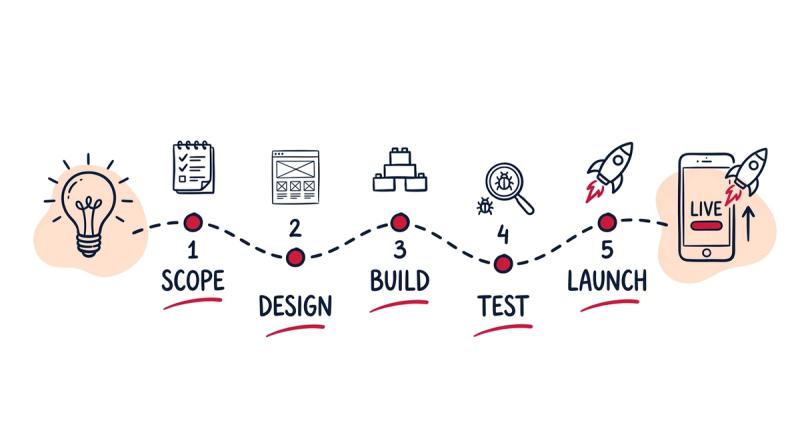
On a typical small business project, design is usually around a quarter of the effort. Content, meaning the writing and organizing of what each page says, is another quarter and is the part most often underestimated. The actual building is roughly a third. The remainder goes to testing across devices, fixing what testing finds, and launching properly.
The surprise for most people is that the visual design isn't the largest slice. When a project runs over, it's almost never because the design took too long. It's because nobody decided what the pages should say until the build had already started, and the writing became a bottleneck that stalled everything behind it.
This is worth knowing before you sign, because it tells you which question actually protects your timeline. Not how long will the design take. Who's writing the words, and when.
The Costs Almost Nobody Quotes You
The build price isn't the whole number, and this is where people get surprised a year in.
- Hosting, usually 100 to 600 dollars a year for a small business site.
- Domain registration, usually 15 to 50 dollars a year.
- Maintenance and updates, which covers security patches, plugin or dependency updates, and fixing things that break. Budget somewhere between 500 and 3,000 dollars a year depending on how complex the site is.
- Content changes, either your time or someone else's, every time your services or pricing shift.
If a quote doesn't mention any of these, ask. A site nobody maintains slowly stops working, and the failures tend to be quiet ones like a broken contact form that nobody notices for two months.
How to Tell Whether a Quote Is Fair
Price alone won't tell you. These questions will.
- What exactly is included, page by page?
- Who writes the words?
- What happens after launch, and what does that cost?
- Do I own the site and the domain outright?
- Can I edit the content myself without calling you?
That last one matters more than people expect. A site you can't update is a site that goes stale, and a stale site quietly costs you more than the difference between two quotes.
When Cheap Turns Out to Be Expensive
The lowest quote is sometimes genuinely the right choice. It's worth knowing the specific ways it goes wrong, because they're consistent.
- You don't own it. Some cheap builds live on a platform you rent. Stop paying and the site disappears, and there's nothing to move elsewhere.
- You can't change anything. If every text edit requires a paid request, you'll stop making them, and the site will drift out of date within a year.
- It was never built to be found. A site with one page and no structure has nothing for search engines to work with, so you end up paying separately later to fix what should've been designed in.
- It gets abandoned. A one time build from someone who has moved on leaves you with software that ages and nobody to maintain it.
The pattern is that the cheap option shifts cost into the future rather than removing it. Sometimes that's a reasonable trade when cash is tight now. It's only a mistake when nobody told you it was the trade being made.
Match the Spend to the Stage You're In
The right budget is the one that matches how much your business depends on the site. If customers find you by word of mouth and the website is a business card, a modest build is genuinely correct. If the site is where people decide whether to call you, it's worth building properly, because the gap between a site that converts and one that doesn't is far larger than the gap between two price tiers.
When we rebuilt the site for Bakken Property Management, the money went into structure and positioning rather than decoration. The site speaks to property owners instead of tenants, because owners are the customer. That decision cost nothing extra and changed what the site was worth.
That's how we think about web design generally. Spend where it changes the outcome, skip what only looks expensive, and be honest about which tier your business is actually in.