It's a genuinely deflating moment. The site is finished, it looks good, and you search for your own business and find nothing. Or worse, you find a competitor you've never heard of sitting where you expected to be.
The good news is that this almost always has a specific cause rather than a mysterious one. Work through the following in order, because the early items are both the most common and the fastest to fix.
First, Confirm Google Has the Site At All
Search for site:yourdomain.com in Google, replacing that with your actual domain. This asks Google to show only pages it has stored from your site.
- If nothing comes back, Google doesn't have your site indexed. Nothing else in this article matters until that's fixed.
- If pages come back, you're indexed, and your problem is ranking rather than visibility. Skip ahead.
If you aren't indexed, the usual culprits are a site that launched very recently, a leftover setting from development that tells search engines to stay away, or the absence of a sitemap. Set up Google Search Console, submit your sitemap, and request indexing. This is free and takes about twenty minutes.
The Technical Blockers Worth Ruling Out
If Search Console says your pages are excluded rather than simply unknown, a handful of specific causes account for most cases.
- A leftover noindex tag. Sites are often built with a tag telling search engines to ignore them, and somebody has to remember to remove it at launch. Frequently nobody does.
- A robots file blocking crawlers. Same story, a development setting that survived into production.
- Canonical tags pointing elsewhere. A canonical tag tells search engines which version of a page is the real one. If every page points at your homepage, you're telling Google the rest of the site is duplicate content and shouldn't be indexed separately. This one is invisible without looking at the page source, and it's more common than it should be.
- Content that only appears after scripts run. If the text is assembled in the browser rather than delivered in the page, crawlers may see an empty shell.
- Pages nothing links to. A page with no internal links pointing at it is hard to discover and reads as unimportant.
Search Console will name most of these directly under its indexing report, which is why setting it up is the first thing worth doing rather than the last.
You're Searching in a Way Nobody Else Does
This one catches almost everyone. You search for your business name, or for something like best plumber in town, and read the result as a verdict on your site.
Two things are happening. Google personalizes results based on your history and location, so what you see isn't what a stranger sees. And your customers aren't searching the way you're. They search for the problem, not for you. Somebody with a leak doesn't search for your company name, because they don't know it yet.
Try searching in a private window, and try the phrases a customer would actually type.
Your Google Business Profile Is Missing or Unverified
For any business serving a local area, this matters as much as the website and sometimes more. The map results and the local pack are driven by your Google Business Profile, not by your site.
If your profile doesn't exist, is unverified, or has an address or category that doesn't match reality, you'll be invisible in exactly the searches that convert best. Claim it, verify it, choose the most specific category available, and make sure your name, address, and phone number match your website exactly.
Your Pages Don't Say Anything Specific
Google needs a reason to show one page rather than another. A homepage that says you offer quality service with a commitment to excellence gives it nothing to work with, because so does everyone else's.
Pages rank when they're specifically about something.
- One page per service, named the way customers name it.
- One page per area you serve, if you serve several.
- Real detail about what the work involves, what it costs, and what happens next.
This is the single biggest difference between sites that rank and sites that don't. Not keyword tricks. Just pages that are unambiguously about one thing.
When we built the site for Juneau Poop Scoop, the market was small enough that only a handful of searches existed at all. Giving each service and each area its own page meant every one of those searches had somewhere specific to land, rather than all of them competing to be answered by a single homepage.
The Site Is Simply Too New
Search engines are cautious about new sites. A site that launched three weeks ago is usually not going to outrank one that has been accumulating pages, links, and visits for six years, regardless of how good it's.
Realistic timelines look roughly like this.
- Weeks one to four, indexing happens and you begin appearing for your business name.
- Months two to four, you start showing up for very specific long phrases.
- Months four to twelve, competitive local terms become achievable if you keep publishing and earning mentions.
If you're four weeks in, nothing is wrong. You're early.
You're Competing for Words You Can't Win Yet
Some phrases are contested by national companies with enormous budgets. A new local business isn't going to win those, and pointing your whole strategy at them wastes months.
The way through is to start narrower than feels comfortable. Longer, more specific phrases have less competition and better intent behind them anyway. Somebody searching a very specific question is usually closer to buying than somebody searching a broad one.
A workable sequence looks like this. Begin with phrases that name your service and your town together, which almost nobody with a national budget bothers competing for. Add the questions customers ask before hiring, since those pages are useful regardless of ranking. Only once those are landing consistently is it worth going after the broad category term, and by then you'll have the pages and the credibility to have a chance at it.
Rule Out an Actual Penalty
This is rare, and worth checking only after the above, but it does happen. Search Console reports manual actions directly, and if one exists it'll say so plainly along with the reason.
The usual causes are inherited rather than deliberate. A domain bought secondhand that carries history from a previous owner, or an SEO provider from years ago who built spam links that are now counted against you. If there's no notice in Search Console, there's no penalty, and you can stop worrying about it and go back to the ordinary explanations, which cover almost every case.
Work Through It in Order
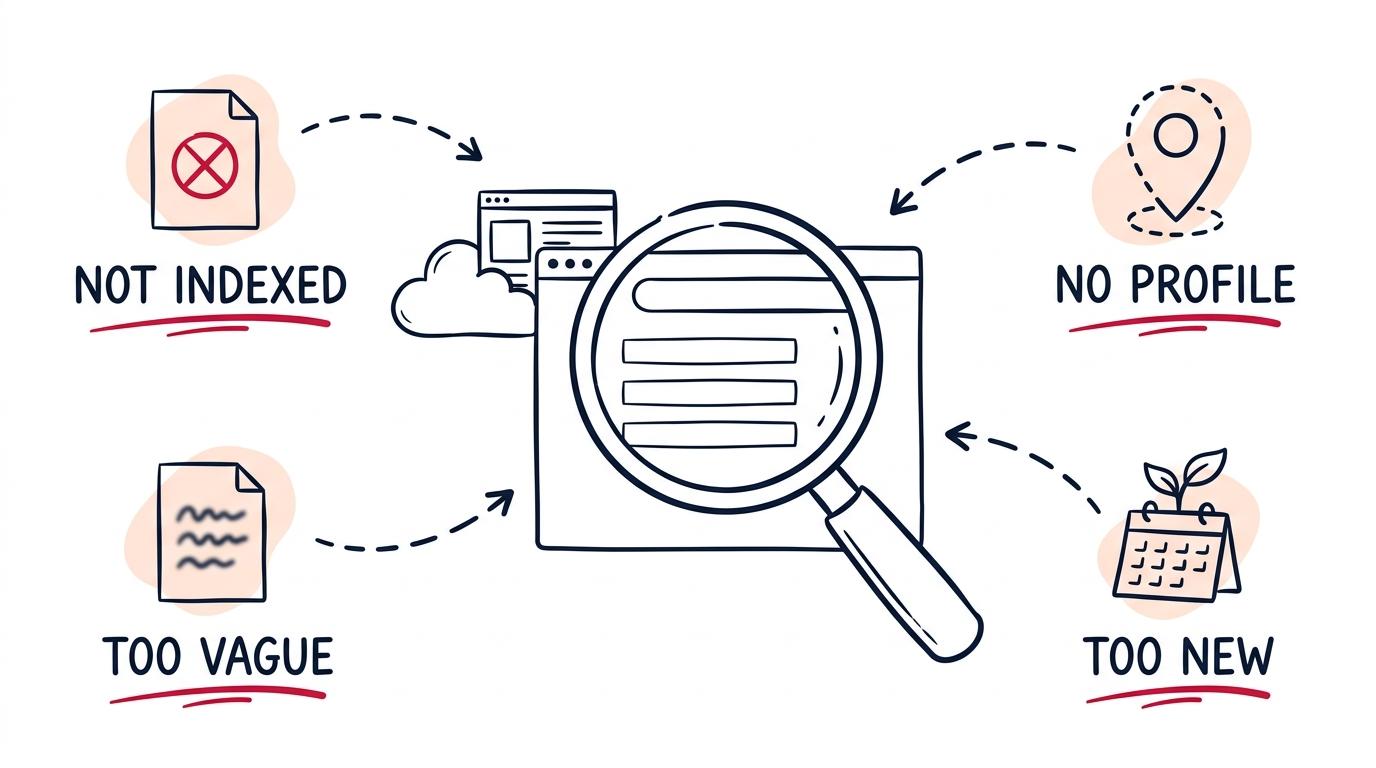
Most invisible websites aren't suffering from anything exotic. They aren't indexed, or they've no Google Business Profile, or their pages are too vague to rank, or they're three weeks old and being judged too early. Check those four before you consider anything more complicated.
If you've worked through all of it and still can't find yourself, that's usually the point where an outside look helps. It's the sort of thing our SEO work starts with, because there's no sense optimizing a site that hasn't cleared the basics yet.